Henan Zhonglian Huazhu Machinery Equipment Co., Ltd.
Investors often begin an autoclaved aerated concrete project by asking for an equipment price. However, a reliable quotation cannot be prepared from annual capacity alone. The factory must also have suitable land, electrical power, steam, process water, compressed air, raw-material storage and an operating team. If these conditions are not checked early, the project may face expensive redesigns after equipment purchasing has already started.
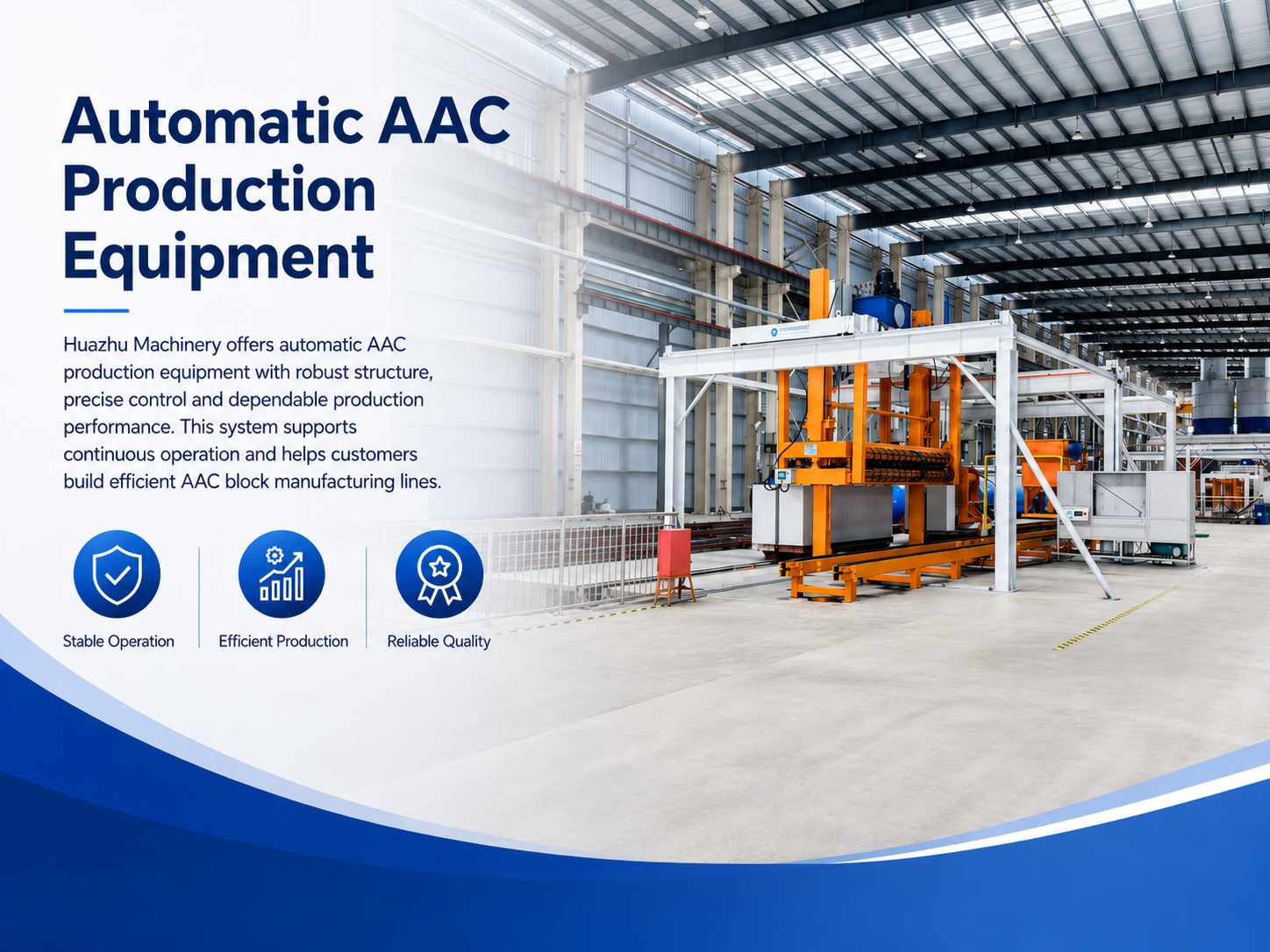
This guide explains the main AAC plant utility requirements for production lines from 50,000 to 500,000 m³ per year. It is written for investors planning AAC block or reinforced AAC panel production in Central Asia, Russia, Southeast Asia, Africa and other overseas markets. The figures below are preliminary planning ranges, not guaranteed consumption values. Final requirements must be calculated from the selected process, raw materials, product density, operating shifts, mould size, automation level, local climate and equipment configuration.
Before ordering equipment, combine this utility review with a complete AAC plant layout, a detailed AAC plant cost analysis and a process-specific equipment list.
Why Utility Planning Must Come Before the Final Equipment Quotation
An AAC factory is a connected process rather than a collection of independent machines. Grinding capacity affects electricity demand. Mould cycle time affects the number of moulds and pre-curing space. Autoclave size and production rhythm determine peak steam demand. The packaging method affects labor, forklift traffic and finished-product storage. A change in one section can therefore influence several other engineering decisions.
Early utility planning helps the investor answer five critical questions:
- Can the selected site support the target production capacity?
- Does the local grid provide enough stable power for the installed load and simultaneous demand?
- Can the boiler and steam network support the required autoclave cycle?
- Is sufficient water available, and can condensate and process water be recovered?
- How many operators and maintenance personnel are needed for the proposed automation level?
Resolving these questions before civil construction reduces the risk of undersized transformer rooms, restricted crane access, long steam pipes, rail conflicts, inadequate raw-material yards or expensive changes to foundations.
Preliminary Utility Ranges by Annual Capacity
The following table is suitable for early feasibility discussions. It should not be used as a construction specification or utility purchase guarantee.
| Annual capacity | Typical plant area | Installed power | Preliminary steam capacity | Typical workforce |
|---|---|---|---|---|
| 50,000 m³/year | 15,000–25,000 m² | 350–500 kW | 4–6 t/h | 25–35 |
| 100,000 m³/year | 20,000–35,000 m² | 500–750 kW | 6–8 t/h | 30–45 |
| 150,000 m³/year | 25,000–40,000 m² | 650–900 kW | 8–10 t/h | 35–50 |
| 200,000 m³/year | 30,000–50,000 m² | 800–1,100 kW | 10–15 t/h | 40–60 |
| 300,000 m³/year | 40,000–65,000 m² | 1,100–1,500 kW | 15–20 t/h | 50–70 |
| 500,000 m³/year | 60,000–90,000 m² | 1,600–2,300 kW | 25–35 t/h | 65–90 |
Actual values may fall outside these ranges. For example, wet ball milling normally creates a different electrical load profile from a process using purchased fine material. A panel plant adds reinforcement processing and corrosion-protection equipment. A highly automated packaging and handling system may increase installed electrical load while reducing direct labor. Cold climates may require insulated steam lines, heated process areas and additional building energy.
Land and Factory Building Requirements
The site must accommodate more than the main production workshop. A complete project may include sand or fly-ash storage, lime and cement silos, gypsum storage, slurry tanks, grinding, batching, pre-curing, cutting, autoclaving, separation, packaging, finished-product storage, a boiler house, transformer room, laboratory, maintenance workshop, spare-parts store, internal roads and administrative facilities.
A linear material flow is usually preferred: raw materials enter at one side, pass through preparation, casting, cutting and autoclaving, and finished products leave from the opposite side. This reduces reverse handling and conflicts between raw-material trucks, forklifts, autoclave carts and finished-product vehicles. The detailed arrangement must still respond to the actual land boundary, prevailing wind, road entrance, elevation, drainage and local setback rules.
When comparing sites, investors should provide a dimensioned plot plan rather than only the total area. A long, narrow parcel may contain enough square metres but still be unsuitable for autoclave arrangement or rail circulation. The layout engineer also needs the location of existing buildings, high-voltage lines, underground services, restricted zones, road access and possible future expansion.
Important civil and building checks
- Soil bearing conditions for machine foundations, silos, autoclaves and cranes
- Clear workshop height for tilting hoists, cranes and maintenance lifting
- Floor level coordination between mould rails, cutting sections and autoclave tracks
- Drainage for slurry areas, equipment cleaning and rainfall
- Vehicle turning radius and loading space for long or heavy deliveries
- Reserved corridors for steam, water, compressed air, cable trays and ventilation
- Separation and compliance requirements for the boiler house, fuel system and pressure vessels
For a tailored concept, see HUAZHU’s AAC factory planning and layout service.
Electrical Power Requirements
Electricity is required for raw-material preparation, ball mills, slurry pumps, batching, mixers, mould circulation, cutting machines, hydraulic stations, cranes, autoclave cart movement, separation, packaging, dust collection, air compressors, water pumps, lighting and control systems. The installed power shown in an equipment list is not the same as the plant’s actual operating demand.
Electrical design should distinguish between connected load, simultaneous demand, starting current and expected energy consumption. Large motors may need soft starters or variable-frequency drives, depending on the equipment and grid conditions. The transformer, switchgear and incoming supply should include reasonable reserve for auxiliary systems and future expansion, but unnecessary oversizing should also be avoided.
Information needed for electrical design
- Local voltage, frequency and phase standard
- Available grid capacity and permitted maximum demand
- Grid stability, outage frequency and voltage fluctuation
- Distance from the utility connection to the plant transformer room
- Required control standard and locally approved electrical components
- Need for standby power for safety, control, lighting or essential pumps
- Ambient temperature, dust, humidity and enclosure protection requirements
The final electrical load schedule should be prepared from the approved equipment list. It should identify motor ratings, duty factors, control voltage, cable routes, earthing, lightning protection and emergency-stop philosophy. Electrical rooms should remain accessible for maintenance and protected from slurry, dust and excessive heat.
Steam and Boiler Requirements
Steam curing inside autoclaves is essential to develop AAC’s required structure and performance. The boiler must provide adequate steam flow and pressure for the selected autoclave arrangement and production schedule. A boiler selected only from annual capacity can be misleading because peak demand depends on how many autoclaves enter the heating stage at the same time.
The steam system should be engineered as a complete network: boiler, feed-water treatment, deaeration where applicable, headers, pressure control, insulated distribution pipes, autoclave valves, condensate handling, flash-steam or heat-recovery options and safe drainage. Pipe diameter, length, pressure loss and insulation quality directly influence heating performance and energy efficiency.
Factors that change steam demand
- Autoclave diameter, length and loading quantity
- Number of autoclaves and overlap between curing cycles
- Cake temperature and moisture before autoclaving
- Target heating, holding and pressure-reduction profile
- Steam pipe length, insulation and condensate return
- Local ambient temperature and seasonal conditions
- Boiler fuel type, efficiency and local emissions requirements
Natural gas, coal, biomass, oil or electric boilers may be considered where legally and technically suitable. Fuel availability, delivered cost, emissions rules, water quality, operator capability and service support should be evaluated before selection. Pressure vessels and boilers must comply with the applicable regulations of the project country. HUAZHU can coordinate equipment interfaces, but final boiler-room approval and statutory compliance require qualified local engineering and authorities.
Process Water and Water-Treatment Requirements
Water is used in slurry preparation, batching, equipment cleaning, boiler feed and general plant services. The required quality differs by use. Boiler feed water normally needs treatment based on raw-water analysis, while process water must be compatible with the production formula and should not introduce harmful contaminants.
A serious feasibility study should include laboratory analysis of the available water source. Key considerations may include hardness, alkalinity, chlorides, suspended solids, pH and other constituents relevant to the boiler and AAC process. The water-treatment supplier should design the treatment system according to the boiler specification and local water conditions.
Water efficiency can often be improved through controlled reuse of suitable process water, collection of equipment-washing water and recovery of boiler condensate. Reuse must be managed carefully because uncontrolled changes in temperature, solids content or chemistry can affect batching consistency. Storage tanks should provide stable supply during peak demand or short interruptions.
Compressed Air, Ventilation and Environmental Systems
Compressed air may serve pneumatic valves, instruments, packaging equipment and cleaning points. Required pressure, air quality and peak flow depend on the final equipment configuration. The compressor station should include appropriate drying, filtration, receiver capacity and drainage. Long pipe runs and undersized lines can cause pressure loss at critical equipment.
Dust collection is particularly important around lime, cement, gypsum and dry-material transfer points. Enclosed conveying, local extraction and good housekeeping help protect operators and equipment. Grinding and slurry areas may need ventilation and moisture management, while electrical rooms need clean, controlled conditions. Environmental design should also address noise, wastewater, solid returns, boiler emissions and safe handling of aluminum powder according to local law and the project’s process design.
Labor Requirements and Automation Level
Workforce planning should be based on positions per shift, not a single total number. Typical functions include production supervision, raw-material handling, grinding, batching, casting, pre-curing, cutting, autoclave operation, separation, packaging, forklift operation, laboratory quality control, mechanical maintenance, electrical maintenance, boiler operation, warehousing and safety management.
Automation can reduce repetitive handling and improve process consistency, but it does not eliminate the need for trained operators and maintenance technicians. A plant with automatic mould circulation, centralized batching controls, automatic cutting, mechanized autoclave handling and automatic packaging may use fewer direct operators than a semi-automatic plant. However, it requires stronger electrical, instrumentation and preventive-maintenance capability.
Panel production needs additional personnel or automated systems for steel processing, mesh welding, corrosion protection, cage assembly and accurate reinforcement positioning. Investors comparing blocks and panels should review HUAZHU’s AAC panel production line information before freezing the equipment scope.
Raw Materials and Storage Days
Utility and layout calculations cannot be separated from raw-material planning. The plant must identify whether the siliceous material is sand, fly ash or another approved source; how cement, lime and gypsum will be delivered; and how many storage days are required. Seasonal transport interruptions, long international routes and variable local supply may justify larger storage.
Representative samples should be tested before the final process and equipment configuration. Material moisture, fineness, chemical composition and reactivity affect grinding, batching, recipe development and product performance. A supplier should not promise a fixed formula without sufficient raw-material data and production trials.
A Practical Pre-Quotation Checklist
To receive a useful equipment proposal instead of a generic price, prepare the following project information:
- Project country and installation city
- Target annual or daily capacity and planned operating days
- AAC blocks, reinforced panels or both, including product sizes and target density
- Available raw materials and recent laboratory reports
- Land dimensions, site drawing, road entrance and existing buildings
- Available voltage, frequency and grid capacity
- Available boiler fuel, water source and water analysis
- Preferred automation level and local labor conditions
- Required packaging method and finished-product handling plan
- Local standards, environmental rules and project schedule
HUAZHU Machinery uses this information to coordinate process selection, equipment configuration, utility interfaces and preliminary layout. Explore the available AAC production line equipment, or send your project data through the Get a Quote form.
Frequently Asked Questions
How much electrical power does an AAC plant need?
Preliminary installed power may range from about 350–500 kW for a 50,000 m³/year plant to about 1,600–2,300 kW for a 500,000 m³/year plant. The final value depends on grinding, automation, panel equipment and auxiliary systems. Transformer sizing must use the approved motor and load schedule, not only annual capacity.
What boiler capacity is required for an AAC production line?
Early planning ranges may start around 4–6 t/h for a small plant and reach 25–35 t/h for a 500,000 m³/year project. Final boiler capacity depends on autoclave size, number of simultaneous cycles, steam-network losses and the selected curing schedule.
How much land is required for an AAC factory?
A preliminary range is approximately 15,000–25,000 m² for 50,000 m³/year and 60,000–90,000 m² for 500,000 m³/year. Plot shape, raw-material storage, finished-product yard, roads, utilities and expansion plans can be as important as total area.
Can process water be recycled?
Suitable equipment-washing water, slurry returns and boiler condensate may be recovered under controlled conditions. Water chemistry, solids, temperature and formula consistency must be monitored. Boiler feed treatment should follow the boiler supplier’s requirements and local standards.
How many workers are required?
Typical preliminary staffing ranges from about 25–35 people for a small plant to 65–90 for a 500,000 m³/year line. Shift structure, packaging, raw-material handling, maintenance organization and automation can materially change the number.
What information does HUAZHU need before preparing a quotation?
Provide country, capacity, products, raw materials, land dimensions, voltage and grid capacity, boiler fuel, water conditions, automation preference and required packaging. Better project data allows a more accurate equipment list, utility interface and layout proposal.
Request a Customized AAC Plant Utility and Equipment Proposal
Planning an AAC block or panel factory? Send HUAZHU Machinery your country, capacity, raw materials, land dimensions and utility conditions. Our team can prepare a suitable process configuration, preliminary layout, equipment list and quotation.
WhatsApp: +86 138 3825 5450
Get a Quote: https://www.hzaac.com/ToInquiry/